
Digital sovereignty
Design, enforce, and prove sovereignty across every layer of the data path.
Residency is not sovereignty. Control is.
Digital sovereignty is an operational continuity imperative before it is a compliance mandate. Relying on a single provider exposes enterprises to geopolitical pressure, avoidable service outages, and regulatory liability. Isolating workloads into separate jurisdictional enclaves adds policy drift, security blind spots, and complexity.
Where data is stored does not determine who can access it. Providers remain subject to the laws of the jurisdiction they answer to, and some of those laws reach data held abroad.
True sovereignty is engineered into every application, not declared at the infrastructure layer. Three questions define the sovereignty requirements of each application.
Who holds the keys, who can compel access to your data?
Requirements include residency, access, customer-held encryption keys, decryption and inspection boundaries for payload and metadata, and verifiable logging.
Can a third party interrupt your service through a contract change, sanction, or outage?
Requirements include a management plane your teams operate and deployments that ensure continuity through geopolitical disruption.
Can you meet new mandates, relocate, or isolate on your own timeline?
Requirements cover portability across regions and platforms, exit readiness you can prove, and the ability to adopt local or open-source technology.
Digital sovereignty in practice
Sovereignty requirements have become architectural and operational decision points. These are the key patterns shaping decision-making across regions, industries, and governments.
Drawing data boundaries
Organizations are treating data sovereignty as an application-layer requirement, designing enforcement for where payload and metadata get inspected, logged and processed—not only where data is stored.
See F5 data residency and sovereignty solutions
Proving digital resilience
Financial institutions and critical infrastructure agencies are designing provable hybrid multicloud failover into their applications to meet availability thresholds set by evolving global regulations.
See how F5 supports digital operational resilience
Operating air-gapped environments
Governments and critical infrastructure agencies are running classified workloads inside isolated environments, with application delivery and security that operates with no external service dependency and vendor access.
See how F5 secures air-gapped networks
Repatriating workloads
Organizations are relocating workloads from public clouds to sovereign clouds, local providers and private data centers to meet residency and jurisdictional requirements, with delivery and security policy that travels with workloads.
Building sovereign AI applications
Regulated organizations and agencies are building AI applications with sovereignty controls designed into the inference path and the application layer.
Delivering sovereign AI services
Service providers, neoclouds, and governments are building AI data centers for agencies and critical infrastructure, from GPU to inference-as-a-service, with provable tenant separation built into shared infrastructure.
F5 delivers sovereignty that travels with your applications
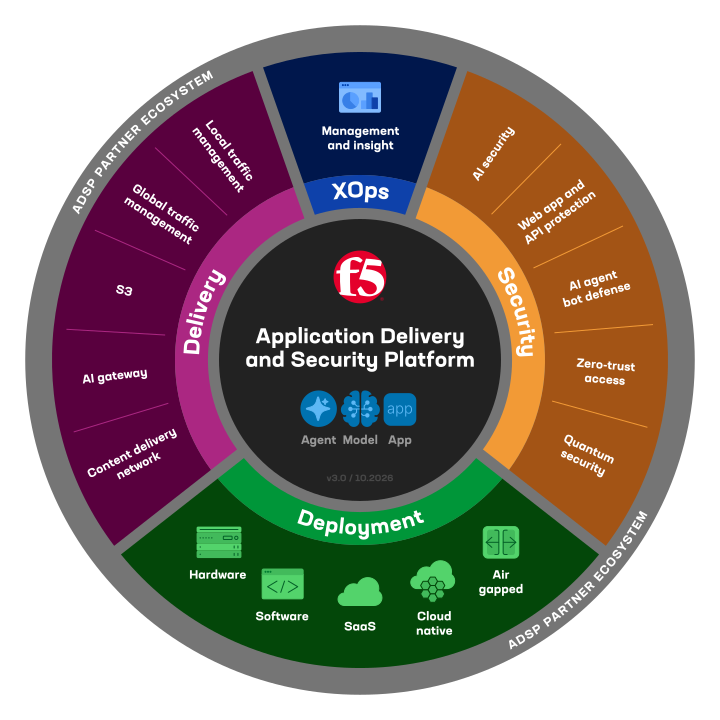
The F5 Application Delivery and Security Platform (ADSP) decouples delivery, security, and traffic governance from the underlying infrastructure, making sovereignty a portable property of the application. Your operational and security posture stays intact when the environment, the cloud provider, or the regulation changes.
Run the same delivery and security services on hardware or software anywhere, with automated failover that stays inside your jurisdiction.
Relocate workloads across clouds, local providers, and private data centers with the same version-controlled policy intact.
Run disconnected workloads with the control plane, licensing, and enforcement operating inside the air-gapped network.
Govern traffic between applications, models, and AI services, with provable separation of data and policy on shared inference infrastructure.
Deploy across any environment, sovereignty level, or region from one platform offering flexible consumption for scaling without re-procuring.
Generate and store audit-ready logs showing traffic patterns, access, decryption, and policy enforcement, inside your jurisdiction.
ADSP is your extensible platform for evolving security and delivery needs.
Why choose F5 ADSP?
Hybrid multicloud
Build for flexibility across every environment

93%
of enterprises operate in hybrid multicloud environments with 19 average locations1
AI inference
Adaptive defense for every AI interaction
78%
of enterprises own their own Inference and use 7 different models on average1
Threat landscape
Centralized visibility to see evolving threats

77%
increase in web attacks and 150% increase in bot activity2
Technology alliances






Resources
Reports
Webinars
Blogs
Articles
INFO ARTICLE
AI security for air-gapped networks
TECHNICAL ARTICLE
Building digital resilience to enable digital sovereignty
TECHNICAL ARTICLE
Disentangling the questions of data sovereignty, and data residency
Case studies
CRITICAL INFRASTRUCTURE
HCWW secures resilient water services in Egypt with F5 ADSP
FINANCIAL SERVICES
Prime bank navigates data sovereignty mandates with F5 ADSP
Frequently asked questions
Digital sovereignty is the principle that an organization's data, applications, and infrastructure remain under the control of, and subject to the laws of, a specific country or jurisdiction. It spans data sovereignty (where data resides), operational sovereignty (who can access and run systems), and technical sovereignty (control over the underlying technology), and it increasingly shapes how enterprises design their application strategy across hybrid and multicloud environments.
Digital sovereignty matters because regulations, geopolitical shifts, and evolving threats now dictate where applications run, where data lives, and who can access it, which directly constrains how you architect and deploy apps and APIs. Meeting these requirements without fragmenting IT into disconnected, region-by-region silos is the core challenge, and it calls for a consistent way to deliver and secure applications everywhere they run.
Air-gapped operations run applications in environments physically or logically isolated from external networks, ensuring sensitive workloads and data never traverse the public internet. They matter for sovereignty because the most highly regulated industries and government agencies often mandate this isolation to protect classified or critical data, which means your application delivery and security capabilities must function reliably even in disconnected, self-contained environments.
F5 supports digital sovereignty through the F5 Application Delivery and Security Platform (ADSP), which is designed to deliver and secure applications and APIs consistently wherever they need to run, including on-premises, in multiple clouds, at the edge, and in air-gapped deployments. This deploy-anywhere approach helps organizations protect business continuity while meeting data residency and operational control requirements from a single platform.
For AI workloads, digital sovereignty means keeping the data, models, and inference that power AI applications within a defined jurisdiction and under your organization's control. This is critical because AI systems process large volumes of sensitive data and often rely on distributed infrastructure, so meeting residency, operational control, and isolation requirements, including air-gapped deployments, is essential to using AI while staying compliant and protecting proprietary data and models.
F5 helps secure and govern AI workloads through the F5 Application Delivery and Security Platform (ADSP), which extends the same deliver-anywhere, secure-everywhere model to AI applications and APIs. Capabilities such as F5 AI Gateway help organizations protect and control the traffic between applications, models, and AI services, so enterprises can run AI across data centers, clouds, edge, and air-gapped environments while keeping data and models within their sovereign boundaries.